Failing Forward: Q&A on What It Takes to Bring AI to CTE Classrooms
When it comes to bringing AI into Career and Technical Education (CTE), there is no single, one-size-fits-all playbook. Every institution faces a unique set of regional workforce demands, faculty needs, and technical hurdles. Navigating this fast-moving landscape can feel overwhelming, leaving many program leaders wondering how to move past the initial phase of acquiring AI software and into a strategy that actually lasts.
While there are many paths to success, one especially powerful approach is to look at AI integration as a connected ecosystem rather than an isolated IT project. By intentionally linking hands-on student projects, robust faculty professional development, and strategic community outreach along with strong industry partnership(s), a program can build deep institutional momentum around AI while positioning itself as a regional innovation hub.
This is exactly how Dr. Thomas Pigg—Dean of the School of Business, Industry and Technology, Executive Director of Workforce Solutions, and a current member of the Perkins READI AI Fellowship—tackled the challenge at Jackson State Community College.
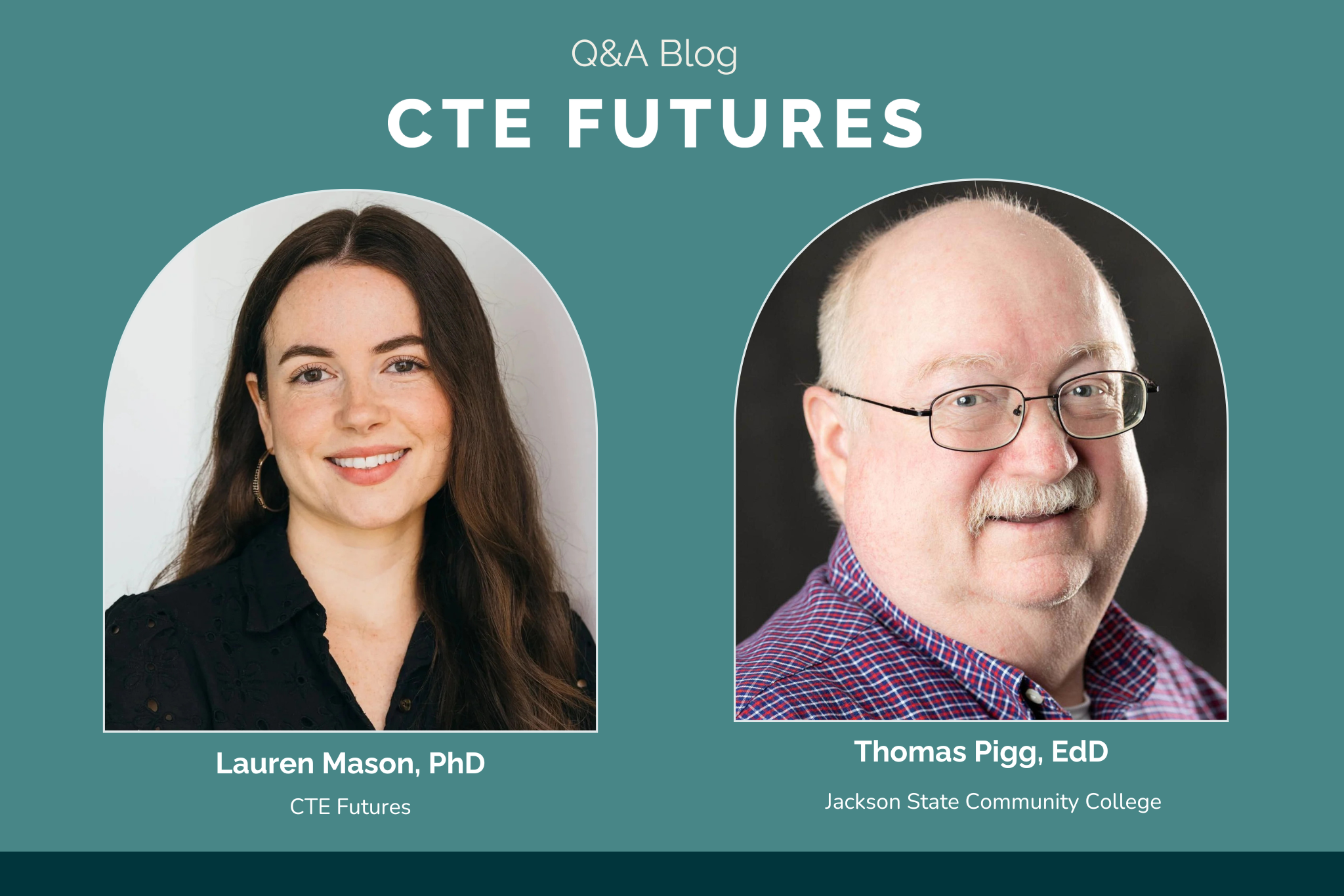
In this post, Lauren Mason, PhD, sits down with Dr. Pigg for a candid conversation about how Jackson State designed this multi-pronged approach, the unexpected hurdles they faced along the way, and what it truly looks like to "fail forward" into sustainable AI integration.
Lauren: Over the past year, you have co-piloted a project that bridges classroom learning with statewide industry leadership. Can you tell me about the work that you’re doing?
Dr. Pigg: We started this project out not knowing exactly what direction it would take us. The original thought was that we would try to get CTE faculty more “in tune” and comfortable with AI. We only had a few faculty members who were really interested in AI, and they were at a variety of different stages. We just thought, let's apply for this grant and see if we can spur some faculty development, start involving some students in the process of learning with AI, and begin developing some industry partners.
In a nutshell, we focused on Computer Information Technology, Engineering Systems, and Health Sciences as our three pilot programs. First, we started with a couple of one day workshops just to get a foothold and foundation for understanding the basics of AI with a little help from our faculty resident experts in AI.
They had some really good insight from projects they had worked on with AI. But here's a problem we ran into: there's a lot of AI platforms out there. Everybody knows about ChatGPT and Copilot, but there are a variety of tools. We could purchase Copilot because it was an approved platform, but we were also looking at some other options. The problem was that it would take so long to get approval to test them that we couldn't purchase the paid versions, so we resorted to free versions of the platforms. There were even some banned AI platforms that came down the pike.
Securing the right AI platform is another challenge we face not just here in education, but industry faces some of the same things.
We took this insight from our resident AI experts and we got together faculty with our industry partners, including Toyota Boshoku of Tennessee, West Tennessee Healthcare, and Jackson Energy Authority. We put our heads together and started trying to discover where AI adoption is across our region.
Our industry partners were at various stages of understanding. We had a couple partners that were just in the infancy stages — they really knew they needed to learn more and they wanted to learn from us. We also had an industry partner that was a little bit further along who we felt would help us to gain some ground. Very quickly, we discovered that we had a lot to learn, and we were going to try to do the best we could to collaborate and learn together.
Lauren: Your pilot ran across Engineering Systems Technology, Health Sciences, and Computer Information Technology. You started out testing student modules using Raspberry Pi systems. What happened when the rubber met the road?
Dr. Pigg: Our initial plan for the fall semester was to engage in various brainstorming meetings to try and identify faculty development opportunities, AI platforms to invest in, and project ideas that we could implement in our CTE classes during the following spring semester.
Raspberry Pi was a project that our engineering systems faculty member wanted to explore. Our industry partner Toyota Boshoku, along with our faculty member, Ben Lawrence, actually had the idea to pilot the use of AI. Basically, what we wanted to do was to build a standalone AI platform, or “air gap” if you will, so that it was a very sterile environment. We would control all the data that was going to be analyzed by the various AI platforms. We set out to try to find a device that would be this AI computer, and the Raspberry Pi was an inexpensive way to explore. A Raspberry Pi packs all the components of a standard computer – a processor, memory, and ports – onto a small circuit board, making it affordable, versatile, and efficient.
Let’s just say it was around a $500 purchase. We got this device in, and it was a pretty neat way for us to see how AI could be used in a sterile environment to use local, sensitive, confidential data and be able to not be influenced or biased by any external AI access to information through the internet that might pollute the data in some form. But we did find out pretty quickly that the Raspberry Pi just didn't have the horsepower that we needed.
We ended up buying a more powerful Dell AI box. It was more like a $5,000 purchase. We discovered pretty quickly that AI is very fast changing and there's a lot to learn. You kind of have to take a few baby steps, and the Raspberry Pi was a good baby step.
We didn't waste our money and we're still able to use it, but we did graduate to a more powerful machine.
Lauren: One of the biggest opportunities you identified was teaching students to use AI as a decision-support tool rather than a shortcut. How did your Engineering partnership with Toyota Boshoku help inform this approach?
Dr. Pigg: We learned pretty quickly that having industry back us up and say, “This is what needs to be done,” is valuable. It’s one thing when a faculty member or an educational administrator says, “We really need to have this,” but it’s another when employers articulate and validate industry needs.
When we started working with industry, we also started to see how they’re in the same boat we are right now. They are figuring out where AI actually fits, and our partnership allowed us to join them in that process. For example, we had the opportunity to work side by side with Toyota Boshoku on a project that would help make their production better while involving faculty and students.
I’ve had the opportunity to speak to several groups of faculty, some that are pro-AI and some not so much, and a lot of the work is trying to help them to understand that AI is something that we work together with.
“It's not that AI tells us what to do, and then we do it. We use AI as a tool to help us, whether it's to solve problems, write papers, create monthly reports, and so on. AI can be our assistant and help us solve problems.”
AI really works well in CTE because we're in situations where if we've got a problem, we've got to start troubleshooting, and AI can help us to troubleshoot.
For instance, if we're a maintenance technician out on the plant floor and there's a problem that occurs, AI is not always going to be able to recognize the things that we can recognize. You might have a worker that may have accidentally broken something or misinterpreted some type of output. AI may not be able to recognize that nuance, but it may help identify when something started to go wrong, and then we can start piecing things together.
I think that's co-intelligence (referring to the Applied Co-Intelligence model, published earlier this year): it's not just us relying on AI to do it all.
It can help us focus on the important pieces and give us an opportunity to do things more efficiently. That's what we're trying to convey to the students. We don’t want them to use it to just write their reports. Instead, it can help students get the basics of it started, and then they can apply their critical thinking, skills, and knowledge to create a strong and accurate finished product.
Lauren: Overhauling curriculum is a heavy lift. What kind of tangible, behind-the-scenes support did leadership have to provide to keep faculty engaged without burning them out?
Dr. Pigg: Though not originally meant to be part of the READI AI grant, we created working groups amongst our faculty. We had those that use AI to some extent and embrace it and others who think AI is bad and don’t use it at all. We brought together 15-20 faculty members in a room to have small group discussions. There's a lot to discuss and a lot to filter through. And when it comes to the part of incorporating AI into the classroom, even the administration needs to figure out what they're going to do. How are they going to support faculty?
Some of what we're doing right now with Toyota Boshoku, for example, requires stipends to help support the faculty for their time and efforts to develop these partnerships, even during the summer break. It takes time to develop curriculum and it takes time to develop activities, especially when we're trying to involve industry.
I mentioned earlier having an air-gapped AI device that basically has isolated data so we don't have to worry about any outside biases in our Engineering Systems Technology work? The same thing happens in healthcare. Outside biases can influence diagnoses based on biased or incorrect data that AI receives.
“There's a lot of need for support on the faculty side to give them the time and the tools necessary to think critically about these tools.”
At Jackson State, we've got support, because our administration really does support us advancing AI.
Lauren: The pilot culminated on April 8 with a major AI Summit, inviting healthcare professionals, external stakeholders, and state leaders. What surprised you most about how that day unfolded?
Dr. Pigg: I think that one of the biggest surprises was that we reached a lot more folks than we thought we would or could! The summit was not even in the picture until midway through the fall semester. We thought it would be neat to bring together some of our industry partners, faculty, and students to talk to one another during a small-scale summit in the spring. It turned out to be something bigger than we expected. If you include both in-person and online participants, we had over 200 folks that attended.
We had student-led demonstrations in healthcare, computer information technology, and engineering systems, during which our students were able to demonstrate their project results. That was a huge part of the day.
We also had the Tennessee Board of Regents there, along with our county mayor who spoke on a practical view of AI use. Kyle Spurgeon, the CEO of our Greater Jackson Chamber, also spoke about his experience using AI over several years. We followed that up with a widespread panel discussion of industry professionals, including someone from banking, industry, healthcare, and education, who talked about some of the challenges with AI.
I think it was all very well received by our audience, who consisted of industry, education, and even some students. It was a pretty action-packed day, and folks walked away with a sense of, “Okay, AI is maybe not as scary as I thought it might be.” I think it helped AI become more visible for the community.
Watch highlights from the Summit to hear perspectives from faculty, students, local government, and industry leaders on how AI is already shaping the way students learn and professionals work.
Lauren: Your college is planning to continue this project in the fall semester. What is the number one thing you plan to change or refine based on lessons learned?
Dr. Pigg: We want to expand on creating a more robust infrastructure with AI. Our Toyota Boshoku partnership is ongoing and it’s moving pretty fast. One of the things that we hope to come out of this is another summit next year, so that we can incorporate what we've done and be able to actually see where we can get other industries involved.
I also think that we need to involve more students and continue trying to get industry to be part of the classroom activities, so that it's not just that instructor standing up in front of the class talking about AI. Instead, we have the industry, whether it's manufacturing, healthcare, or information technology, contributing and being involved in the education of AI, so it's a real thing.
I think another thing to tackle is just the idea of where does the AI fit? We need to drive that home more. Referring back to the co-intelligence model, we’re using AI as a tool and assistant. We're not wanting AI to take over – I don't think anybody really wants that. We’re trying to educate both faculty and students on where AI fits and where it doesn't fit, and also to dispel any kind of rumors or false beliefs about AI.
We need to make sure that we are cognizant of what kind of threats that are out there, but at the same time, there are tools that we can use to enhance our lives, our jobs, and our skills. I think that's one of the key takeaways: we need to make sure that we're using AI to advance our workforce. Moving forward, that's really the objective of this READI AI Fellowship.
Conclusion
The biggest lesson is that successful AI integration isn’t about the technology alone—it’s about building an ecosystem that supports students, faculty, and industry together.
The READI AI Fellowship has created space for educators and employers to explore AI side by side to help ensure CTE programs stay relevant and learners enter the workforce with the skills they need to succeed in a rapidly changing economy. Learn more about the READI AI Fellowship here.