Applied Co-Intelligence: How Three CTE Programs Keep Humans at the Center of AI
By Lauren Mason, PhD, Co-Principal Investigator of the Perkins READI AI Fellowship

As artificial intelligence continues to reshape work, Career and Technical Education (CTE) programs must equip students to think effectively alongside AI. Fortunately, preparing students for an AI-driven economy does not require a one-size-fits-all approach.
By leveraging our Applied Co-Intelligence (ACI) model, colleges—regardless of their current resources or where they stand on their AI journey—can thoughtfully integrate AI into their curriculum.
Rather than focusing on general AI usage, this model is grounded within specific occupational contexts to reflect the reality that one-size-fits-all AI adoption isn’t possible, or advisable, for CTE programs.
This integrated approach ensures students do not just use digital tools blindly, but instead leverage their own professional expertise to direct technology responsibly and effectively.
The Applied Co-Intelligence Model
The ACI model illustrates the intersection of three core areas: AI mastery, technical proficiency, and human transferable skills.
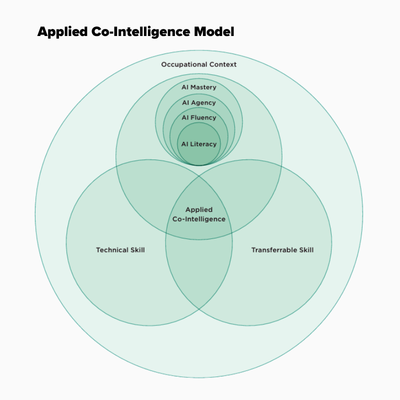
Technical skills represent job-specific, procedural abilities like medical coding or electrical wiring. Transferable skills encompass uniquely human capabilities, such as empathy and ethical reasoning, that allow workers to handle complex, unpredictable situations where AI falls short.
The model recognizes that student expertise progresses along a continuum: AI Literacy, AI Fluency, AI Agency, and ultimately, AI Mastery. As a CTE learner advances, their ability to apply AI within their specific field deepens:
AI Literacy: The student builds awareness of general tools and knows they exist.
AI Fluency & Agency: Through intentional learning, the student begins to integrate tools thoughtfully. They recognize how AI applies to their field, choose the right tool for an occupation-aligned task, and validate that its output is accurate.
AI Mastery: The ultimate goal, demonstrating the deepest level of occupational application. At this stage, the student can critically evaluate, adapt, and optimize the AI system itself.
The ACI model provides a flexible framework that prioritizes human judgment and strategic tool usage. Even for programs taking their very first steps, it offers a clear, manageable entry point to build the essential critical-thinking skills required for an AI-driven workforce.
To show what this looks like in practice, we highlight three colleges that are taking deliberate, small steps to implement AI into their CTE programs in vastly different, yet equally impactful, ways.
College #1: Walters State Community College
Programs impacted: AAS Business – Agriculture Business
Workforce partners: Research Leader, Research Soil Scientist for USDA, and District County Soil Technician
Objectives: Evaluate whether the integration of an "Agent AI" tool improves student AI literacy and mastery of soil science concepts
AI Implementation Approach: Walters State Community College mapped their implementation directly to the ACI model by blending technical knowledge with critical human skills. To track student progress, they began with pre- and post-semester surveys measuring AI literacy and ethical awareness, specifically testing students on complex, cluster-specific concepts like algorithmic bias and the lack of transparency in AI systems used in soil science.
For the core classroom implementation, students were directed to use tools like ChatGPT or Copilot to answer advanced lecture questions. The assignments were deliberately designed so that answers could not be found directly in the course textbook; instead, students had to evaluate the context and use their comprehensive knowledge to validate whether the AI’s output was accurate.
An example of this approach prompted students with a real-world scenario:
“You are a consulting soil scientist evaluating a site for a septic system. What specific soil profile characteristics (like fragipans or macropores) would you look for during a perc test, and how would you explain to a homeowner why their permit might be denied even if the surface soil appears porous?”
This assignment highlights the intersection of the ACI model's core components:
The Technical Skill: Identifying specific soil profile characteristics during a site evaluation.
The Transferable Skill: Communicating a difficult technical denial to a homeowner with empathy and clarity—a uniquely human capability.
To cap off the semester, students applied these skills to their final project, where they were given the autonomy to use their own knowledge, the course text, or an AI tool to develop a comprehensive nutrient management plan for a specific agricultural area.
The Outcomes: Higher Literacy and Stronger Academic Performance
The instructor’s findings highlight the benefits of this structured approach. First, students in the spring course who actively integrated AI showed significantly higher gains in AI literacy compared to the fall cohort, who did not use the technology.
The spring students also achieved similar, strong gains in overall course learning outcomes. This suggests that using AI tools to navigate complex lecture questions and final projects did not serve as a shortcut; instead, it actively promoted deeper learning and stronger subject-matter comprehension for these agriculture students.
Next Steps: Moving Along the Continuum
Reflecting the need for continuous iteration when implementing AI, the instructor has identified three key next steps to evolve the course:
Refining Prompting and Citation: Future cohorts will focus on improving prompt generation and formal AI citation. This addresses the common challenge of students using AI without reporting it, or simply lacking the knowledge of how to cite its contributions effectively.
Integrating Advanced Industry Tools: The instructor plans to introduce smart sensors, environmental controls, and predictive software. Moving beyond general AI by giving students hands-on access to the technologies used in modern agriculture helps them advance along the ACI continuum—shifting from basic literacy and fluency to higher levels of application where they can choose the right tool, validate data, and critically evaluate the system.
Continuing Professional Development: To maintain the confidence needed to teach these rapidly changing tools, the instructor will continue engaging in specialized professional development, including college-led AI sessions, conferences, and targeted technical trainings.
College #2: TCAT Upper Cumberland
Programs impacted: Welding & Industrial Maintenance
Workforce partners: Welding Werks, LLC
Objective: Embed the Xiris weld camera system and the WeldStudio Pro software platform with integrated AI functionality into instruction
AI Implementation Approach: TCAT Upper Cumberland took a highly technical, industry-aligned approach by embedding a Xiris weld camera system with AI functionality into their hands-on lab. The AI software provides real-time feedback on weld quality and operational consistency. By monitoring critical weld quality variables, the system immediately identifies irregularities when welding conditions deviate from established parameters and alerts the student operator.
The Outcomes: Cross-Departmental Synergy Amid Operational Hurdles
Ultimately, this tool allowed students to see the immediate, cause-and-effect relationship between different welding variables and quality outcomes. Beyond technical skill-building, this exercise served as a powerful catalyst for cross-departmental collaboration, breaking down institutional silos, even despite operational challenges.
Cross-Department Learning: Implementing this system required tight collaboration between the welding, industrial maintenance, and IT departments. Navigating the instructors' heavy workloads and limited time to align schedules across three departments was no easy feat. However, the resulting cross-training allowed welding students to learn about robotic operations and programming, while industrial maintenance students gained a deeper understanding of the welding process.
The ACI Model Alignment: This cross-departmental effort fostered the exact blend of technical proficiency and transferable teamwork skills, grounded in an AI context, that modern employers demand.
Next Steps: Scaling Technology along the ACI Continuum
Learning from their initial rollout, including timeline delays caused by early technical troubleshooting and inconsistent vendor communication, this college plans to optimize their implementation and push students further along the ACI continuum:
Resolving Technical Interference: Continuing to test and refine the hardware to resolve ongoing signal issues. Navigating these real-world system errors helps students move past basic AI literacy into AI Agency, where they learn to critically evaluate and troubleshoot the tools they rely on.
Creating Standardized Resources: Developing training materials and troubleshooting guides to support instructors and students moving forward, embedding the ACI model's focus on foundational AI Literacy directly into the program's standard operating procedures.
Measuring Student Impact: Accessing tools to formally collect student feedback, measure classroom engagement, and track targeted technical and transferable skill development.
Fostering Peer Collaboration: Partnering with other educational institutions implementing similar AI technologies to share best practices, ensuring classroom instruction remains rigorously aligned with evolving occupational contexts.
College #3: Jackson State Community College
Programs impacted: Computer Information Technology, Engineering Systems Technology, Health Sciences
Workforce partners: Jackson Energy Authority, Toyota Boshoku Tennessee, West Tennessee Healthcare
Objectives: Facilitate faculty professional development around AI; Integrate AI-enabled tools into student projects across programs; Prepare and deliver demonstrations during spring AI summit
Implementation Approach
Jackson State Community College implemented a robust, three-pronged strategy designed to build an institutional ecosystem around AI, mapping to the multi-level progression of the ACI model.
Prong 1: Faculty Professional Development and Troubleshooting: Recognizing that instructor confidence is the foundation of AI Literacy, Jackson State built a dedicated faculty training phase. This started with fall semester training on AI platforms to establish foundational knowledge. To help instructors maintain momentum, the college provided ongoing consultation to refine projects as hurdles arose, and offered planning support and additional stipends to ensure sustained engagement.
Prong 2: Embedding AI into Student Projects: Jackson State then introduced occupation-specific AI tools across three distinct CTE disciplines, pushing students from basic literacy into AI Fluency and Agency:
Engineering Systems: Students engaged with AI-enabled hardware, starting with Raspberry Pi systems and later transitioning to advanced, Dell AI-enabled computers.
Health Sciences: Students used AI-driven data analysis projects to evaluate patient-related datasets, intentionally training them to detect and evaluate systemic bias.
Computer Information Technology: AI applications evolved practically over the semester, moving from 3D printing concepts to networking-focused implementations.
Prong 3: Stakeholder Alignment via the AI Summit: The final objective culminated in a spring AI Summit, where students demonstrated their work to a broader community of over 200 educators, employers, and workforce leaders.
Outcomes: The Impact of Framing, Community, and Adaptive Problem-Solving
The key findings from Jackson State’s strategy center on intentional framing, the value of community, and the lessons learned from overcoming early operational roadblocks.
The Power of Purposeful Framing: This college discovered that the way AI is introduced to students and faculty matters. Projects utilizing applied, job-specific approaches increased student engagement. Keeping AI applications tangible and directly tied to an occupational discipline helped faculty commit to integration. This college framed AI strictly as a decision-support tool rather than a classroom shortcut—reinforcing to students that they remain the ultimate experts in their respective trades.
The Value of Community Interaction: The spring AI Summit served as a massive catalyst for institutional growth. Presenting work to regional leaders, including discussions on local economic impact from the Madison County Mayor and the Greater Jackson Chamber CEO, increased faculty confidence and gave them a deep sense of ownership over their work. Cameron Sublett presented core research on the Applied Co-Intelligence framework, while students and faculty led interactive breakout sessions showcasing their technical projects.
Lessons from Troubleshooting Infrastructure: Jackson State’s outcomes were shaped by how they handled early technological roadblocks. Initial classroom testing revealed operational gaps and hardware limitations that restricted project scale. By treating this phase as a live lesson in AI Agency, faculty and students adapted their tech to meet rigorous classroom needs. Ultimately, transitioning to specialized Dell AI computers significantly improved both the feasibility and scalability of the student projects, while formally documenting these collective hurdles allowed instructors to refine and optimize their instructional strategies moving forward.
Next Steps: Sustaining Framework Momentum and Scaling Infrastructure
Moving forward, Jackson State plans to build upon this foundational pilot and actively address their initial hardware lessons by focusing on the following strategic priorities:
Expanding Infrastructure Access: Prioritizing continuous procurement to give more students access to improved computing infrastructure and AI-capable hardware—such as the scaled-up Dell systems—across additional CTE pathways.
Measuring Instructional Effectiveness: Developing formal evaluation tools specifically designed to track student learning outcomes, ACI skill development, and overall teaching efficacy.
Targeted Professional Development: Continuing faculty training with a refined focus on discipline-aligned AI applications rather than broad or generalized tools.
Deepening Industry Collaboration: Maintaining strong ties with regional industry partners to ensure classroom tools and workflows evolve with real-world workforce demands.
Conclusion: Steering the Future of CTE with Applied Co-Intelligence
As these colleges demonstrate, there is no single blueprint for integrating artificial intelligence into Career and Technical Education. Whether starting with localized, text-based prompts or embedding sophisticated hardware directly into laboratory settings, the Applied Co-Intelligence (ACI) model serves as a flexible, accessible roadmap capable of guiding any campus through the integration process.
The reality of adopting such a rapidly evolving technology means that these trailblazing programs are essentially building the ship while sailing it. Instructors and administrators have continuously adjusted, reframed, and adapted their strategies in real time as they encountered unexpected technical and logistical hurdles. Embracing this continuous learning curve is precisely what it will take for CTE programs to survive and thrive moving forward.
To learn more, download the Applied Co-Intelligence: Preparing Career & Technical Education Learners for an AI-Driven Workforce report.