Ergonomic AI: Designing AI Tools That Fit the Human Hand
By Dr. Cameron Sublett
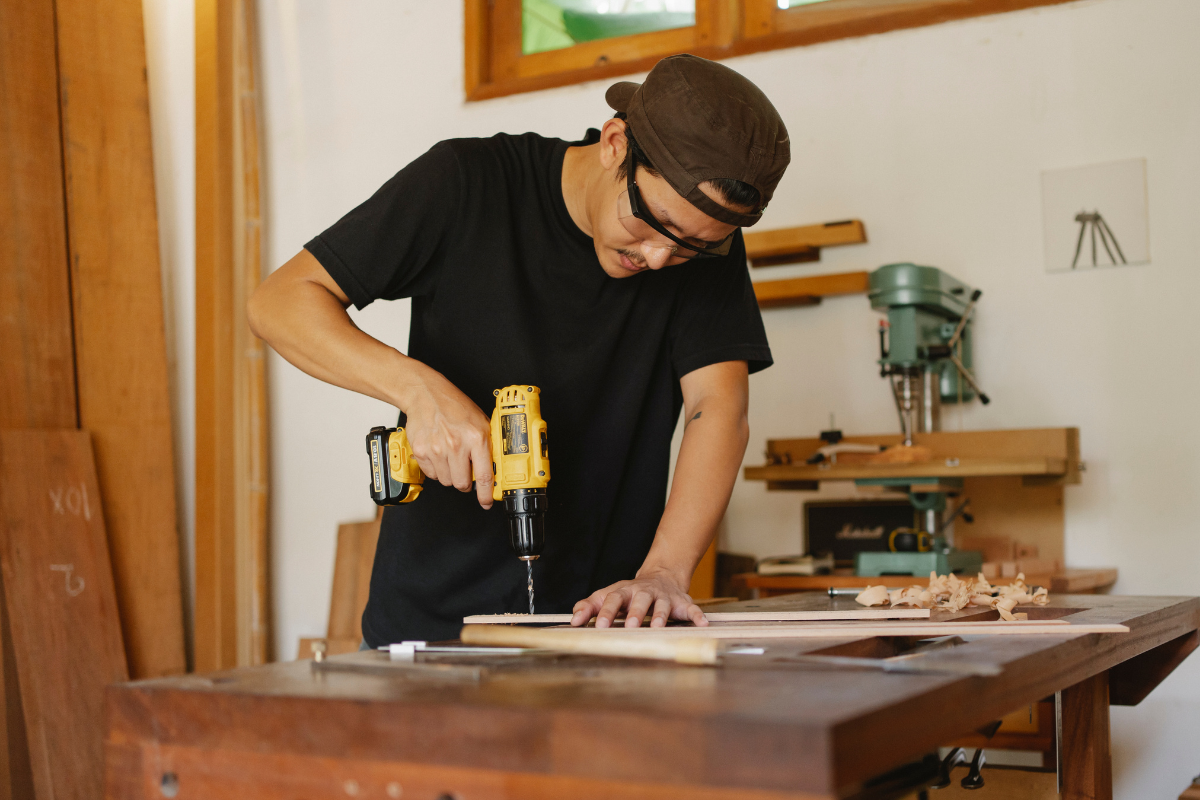
I am in the process of installing a new tankless water heater in my home and while drilling the pilot holes, an idea hit me.
Think about a power drill. Before it existed, carpenters drove screws by hand. It certainly got the job done, but it was slow, exhausting, and imprecise. I can’t fathom doing this today. The power drill didn't just speed things up; it also changed what was possible. It would be much harder to install a tankless water heater by myself without my power drill.
But if you look closely at a modern power drill (like my beloved Makita) you'll notice something else: the tacky grip, the handle molded to the curve of a palm, the trigger positioned exactly where a finger rests naturally, the forward/reverse button within thumbs reach. These aren't afterthoughts. They're design choices that enable their human operators to use the tool at full capacity, with minimal fatigue, and maximum precision.
There’s a name for the science of designing and arranging things so people can use them safely and efficiently: ergonomics. And it’s the metaphor that’s helping me think about how we should be building AI for education and work.
The earliest power drills weren't ergonomic at all. They were heavy, awkward, and built around what the motor could do rather than the hand holding it (keyed chucks, anyone?). Raw capability came first. Comfort, safety, and fit came later through deliberate redesign.
It feels like that's where we are with AI (LLMs, in particular) today. We have extraordinarily capable, general-purpose tools, but little attention paid to whether those tools are actually shaped for the humans using them. The power is there. The “ergonomics” are not.
There’s a lot of talk about building AI that's safe or "human-centered." But the concepts of “human-centered” or “aligned” AI feel abstract. Ergonomic AI offers a design more grounded heuristic borrowed from decades of thinking about how tools, bodies, and brains work together.
An ergonomic tool doesn't just accomplish a task. It respects the limits and rhythms of the person using it. It reduces strain instead of introducing new kinds. It amplifies skill rather than replacing the need for it.
Where Ergonomic AI Meets the Applied Co-Intelligence Framework
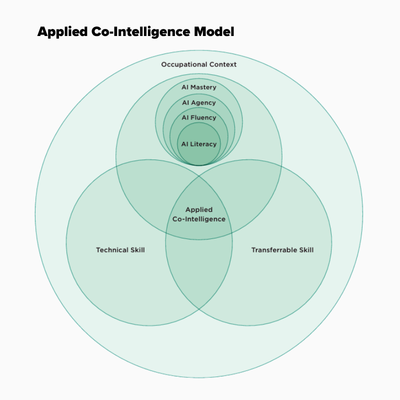
There’s a direct connection to the Applied Co-Intelligence (ACI) framework I've developed, which offers a flexible and manageable way of thinking about how education programs, specifically career and technical education (CTE) programs, can build the skills required for an AI-driven workforce.
The framework rests on three interlocking spheres: technical skills, transferable skills, and AI mastery. Technical skills represent the occupation-specific, credential-bearing abilities at the heart of CTE, while transferable skills include the "human work" that AI can't (yet) replicate like critical thinking, ethical reasoning, and collaboration.
The third domain is AI mastery, which moves learners from basic AI Literacy to Fluency, Agency, and Mastery, where the learner is able to strategically choose and configure the right tool for a complex problem, and critique or adapt the system itself.
Applied Co-Intelligence sits at the intersection of all three, grounded in a specific occupational context, which is where ergonomic AI has the most to say. One of the arguments I make with my co-authors is that CTE providers should resist the pull toward standalone AI courses and modules.
A single "Intro to AI" class, disconnected from the welding shop or the nursing lab or the manufacturing floor, teaches AI in abstract. It doesn't teach a welding student how to use AI-powered design simulations, or a nursing student how to audit an AI-generated clinical note for the subtle context a machine might miss. We captured dozens of these occupation-specific, applied AI use cases across nearly every CTE cluster area.
To make sure every student builds applied co-intelligence, AI has to be embedded into existing CTE courses, using AI tools that are aligned with the industry the student is entering. This is where the metaphor of “ergonomic AI” works for me.
Asking a student in an advanced manufacturing program to use commercial versions of Claude, ChatGPT, or Gemini is like handing students a poorly designed, unergonomic power drill and expecting them to execute efficient and precise work. It might get the job done, but it will be inefficient, high-tolerance work. The tool simply wasn't built for their metaphorical hand, task, or environment.
I get the impression our current pedagogical approaches mirror this same disconnect, handing (or blocking) AI tools to learners with little regard for how those tools align with the specific, tactile, high-stakes work those learners are training to do. The idea of “ergonomic AI” rattling around in my head is about designing a drill so that the skills of our aspiring carpenters can be fully developed and expressed, with minimum fatigue and maximum precision.
I’m not sure where this idea of ergonomic AI goes next. Maybe nowhere. But right now it's giving me a lens to ask better questions as AI tools get deployed across education and workforce systems.
For example, does a tool reduce cognitive load or add to it? Does it fit into existing workflows, or force people to contort around it? Does it make the expert more expert, or simply make the novice dependent? And, for the world of career education, was this tool designed with occupation in mind?
I even wonder if ergonomic AI is less a philosophy and more a design checklist that CTE providers, edtech developers, and industry partners can use when deciding which AI tools belong in which classrooms.
The drill got there eventually, after decades of watching carpenters strain their hands before manufacturers started designing around the human hand rather than the motor inside the machine.
I'd like to think we don't have to wait that long with AI. But it will take the same kind of deliberate attention, including understanding how real students in real CTE programs actually use these tools, where the friction shows up, and where the tool is doing the work of amplifying a skilled person rather than just impressing them.
And with that, I'm back to the tankless water heater.